A Thermodynamic Modeling of Gongronema Latifolium Drying: Thin-Layer Models and Process Effects
Keywords:
Drying kinetics, Moisture ratio, Empirical modelling, Shrinkage, Optimization, Response surface methodologyAbstract
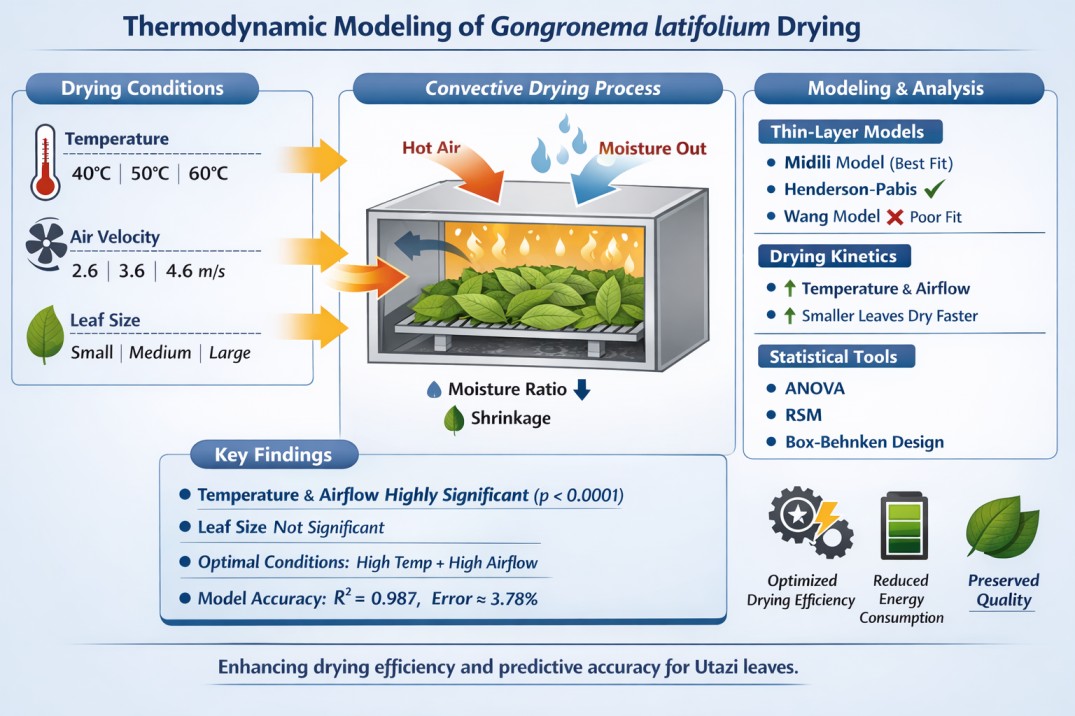
The drying kinetics of Gongronema latifolium (Utazi) leaves were examined in this work under different drying conditions, such as temperature (40°C, 50°C, 60°C), airflow velocity (2.6 m/s, 3.6 m/s, 4.6 m/s), and leaf size (small (0.0028m2), medium (0.0044cm2), huge(0.0063m2)). According to moisture ratio (MR) analysis, drying was expedited by greater temperatures and airflow velocities, with smaller leaves losing moisture more quickly. The Midili model was shown to be the most accurate model across various drying circumstances when seven empirical drying models were used to fit experimental data using curve fitting. The Wang and modified Page II models showed poor fit. The findings demonstrated that while leaf size was not significant (p ≥ 0.0665), temperature and airflow was highly significant on drying behaviour (p < 0.0001). A 3D response surface analysis revealed that higher temperature and airflow improved desirability, resulting in optimal drying efficiency. With an R2 value of 0.9870, the model showed excellent predictive accuracy, accounting for 98.7% of response variability. Reliability of the optimisation model was confirmed by experimental validation, which revealed a small error (3.78%) between simulated and observed shrinkage. By ensuring a balanced optimisation of drying conditions, the desirability function minimised energy consumption without sacrificing product quality. These results offer important new information for improving convective drying processes for agricultural products while maintaining both efficiency and quality