A Finite element analysis of stress distribution during metal cold working under the assumption of plasticity and elasticity
Keywords:
Finite element analysis, Stress distribution, Cold working, Plastic deformation, Residual stressAbstract
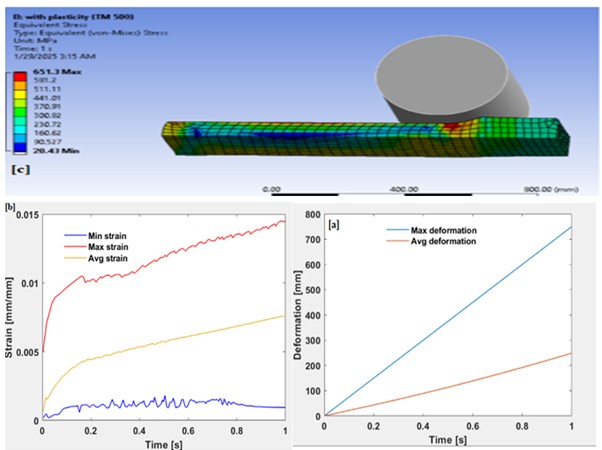
Finite Element Analysis (FEA) is a powerful tool for understanding stress distribution in metal cold working processes, particularly under the assumption of plastic and elastic behaviours. This study investigates the stress distribution in metal cold working processes using finite element analysis (FEA), incorporating the effects of material plasticity, material elasticity, tangent modulus, and temperature. The primary objective is to quantitatively assess how variations in tangent modulus (Et) and temperature (T) influence stress distribution during cold working. A series of simulations were performed using ANSYS mechanical, a commercial finite element software, to model the cold working process on the roller and workpiece. The geometries of the steel roller and rectangular aluminium billet were modelled in ANSYS SpaceClaim while the solution was interfaced and calculated in ANSYS mechanical. Coupled thermal and structural analyses were preformed and the solution algorithms were based on finite element codes. The tangent modulus, a critical parameter influencing plastic deformation, was varied across five levels under the assumption of plasticity; 500 MPa, 750 MPa, 1000 MPa, 1250 MPa, and 1500 MPa. Additionally, the temperature was varied at three levels: 250°C, 300°C, and 350°C to elucidate the influence of temperature during secondary manufacturing process such as metal forming by rolling. These temperature variations were chosen to represent typical preheating conditions used to enhance ductility during cold forming. The material properties, including Young’s modulus and Poisson’s ratio, were set to 71000MPa and 0.33, respectively. The yield stress was initially set to 280MPa to represent the onset of plastic deformation. The FEA results revealed that Increasing the tangent modulus leads to a more constrained plastic flow, resulting in higher stress concentrations at critical deformation zones. Specifically, a 500 MPa increase in Et (from 500 MPa to 1000 MPa) resulted in a 15-20% increase in maximum stress values within the deformation zone. Temperature increment from 250°C to 350°C showed a reduction in both the yield and ultimate tensile strength, with ductility improving with increasing temperature. For instance, increasing the temperature to 300°C resulted in ductility measured at over 17% without tensile fracture. These findings offer valuable insights into optimizing cold working processes by carefully selecting the tangent modulus and temperature to achieve desired stress distributions and material flow, which are essential for preventing defects and improving component performance in industrial applications.