Predicting mechanical properties of aluminum composite reinforced with silicon carbide using artificial neural network and multiple linear regression
Keywords:
Silicon carbide (SiC), Aluminium alloy (Al7075), Stir casting process, Mechanical and physical properties, ANN, MLRAbstract
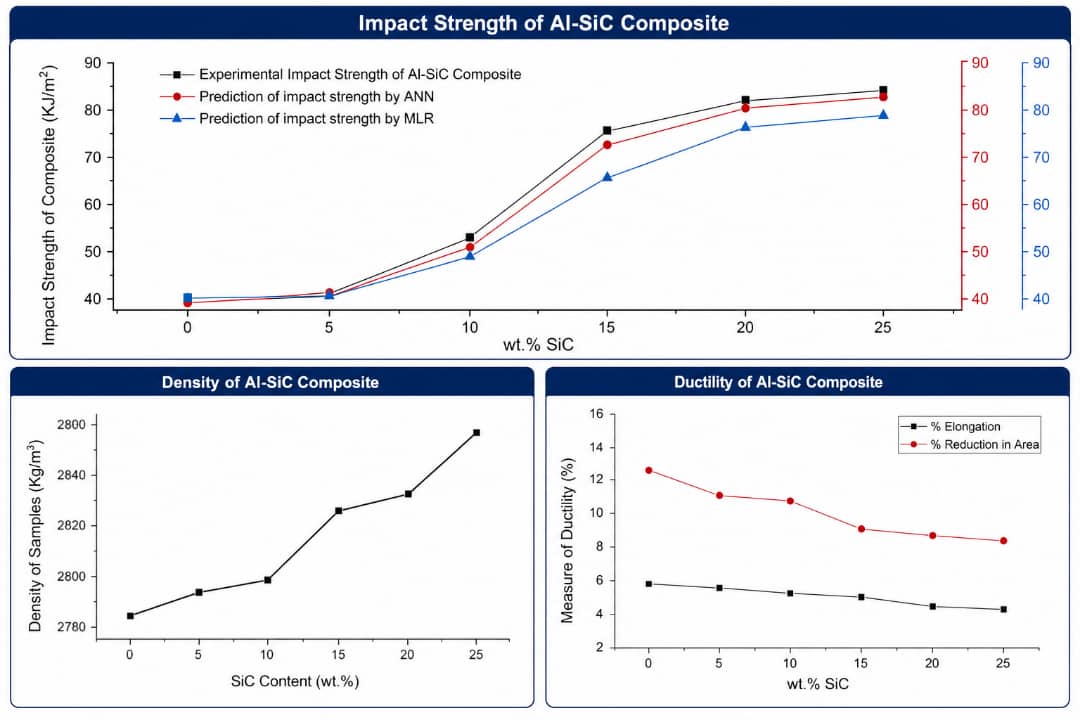
The mechanical and physical properties of the produced Al7075-SiC composite were evaluated. Stir casting was used in the production process to obtain the following composite formulations: 0, 5, 10, 15, 20, and 25 wt.% SiC Al-SiC composites. The samples were machined and subjected to mechanical tests such as hardness, impact, and ductility. The study also involved metallographic examination and physical properties evaluation such as density. The average particle size of silicon-carbide (SiC) was 100µm. Artificial neural network and multiple linear regression (MLR) were used to predict the impact strength of the examined specimen with the composite’s hardness, weight percentage of silicon carbide, and density as the independent variables. Increment in hardness, tensile strength, impact strength and the composite's density w observed as the weight percentage composition of silicon carbide in the aluminium silicon carbide composite increased. 25 weight percentage of silicon carbide content in aluminium matrix composites (AMCs) showed maximum hardness, and impact strengths of 115RHB and 80.91KJ/m2 respectively. 0 weight percentage silicon carbide composite formulation gave the minimum density of 2780.0 Kg/m3 while the highest density of 2880 Kg/m3 was obtained for the 25-weight percentage silicon carbide. The metallographic analysis of the specimens using optical microscopic process showed that stir-casting was responsible for even reinforcement distributions, which also resulted to the optimal physical and mechanical properties of the materials. The error analysis showed that compared to MLR, the ANN model gave predictions more consistent with the experimental impact strength.